Tuesday, 30 July 2013

Record setting rains

Stage = 53cm, Ta = 19.9C, Tw = 15.5C

This July is already the wettest month on record for the Miomote Basin region. Today was another rainy day of fieldwork, but at least the river level was not so high and we could take a discharge measurement.

July is not yet over, but already an incredible 837mm of rain has fallen at Takane, and 628mm has fallen at Miomote. Since 1978, the wettest month was previously 629mm (Takane) and 520mm (Miomote), so we can see that the precipitation this month has been way above these past amounts which were recorded in November 1985.


Friday, 19 July 2013

Major flood

Stage = 82cm, Ta = 19.7C, Tw = 14.4C

Yesterday we had a major flood at Takiya River, with stage reaching 1.8m and discharge estimated at 60m3/s (basin area is 19.45km2). Over July 17-18, 127mm of rain fell on already saturated ground, with a peak intensity of 35mm/h. Under these conditions flash floods often occur at Takiya River with stage rising by as much as a metre in a matter of minutes. The hydrograph below shows two other large floods during the past week, both of which exceeded 1.4m in stage.


Unfortunately the depth and velocity of the flow was too high to allow wading of the river and so we could not take a discharge measurement. I have used a sounding weight and cable from the road bridge, but this method is hardly effective and prone to large errors. I need to investigate other methods and instruments to estimate peak flows at Takiya River.


Tuesday, 9 July 2013

Rainy season arrives

Stage = 59cm, Ta = 20.3C, Tw = 15.8C

This year the rainy season is late in arriving in the Niigata region. The hydrograph below shows a series of rainfall events and peaks during early July. After the first peak, river stage quickly returns to low flow levels, but subsequent rains are more prolonged and we can see the baseflow levels between floods are rising as the soils become more and more saturated and groundwater levels rise. The river flow is swelled by a mix of warm surface runoff and colder deeper groundwater circulation which reduces the temperature of the river, and produces a mist above the water as the warm humid air condenses.


Friday, 28 June 2013

Early summer low flow

Stage = 30.5cm, Ta = 21.5C, Tw = 16.1C

The snowmelt season is over for the Takiya River Basin, and now we are waiting for the rainy season to arrive and swell the flow in the river. The hydrograph below shows that there is a false start to the rainy season around 20 June, after which dry conditions return. Together with late summer in September, this time of year before rainy season has some of the lowest flows of the year.


Tuesday, 4 June 2013

Tail end of snowmelt season


After 2-3 months of snowmelt and sustained moderately high flows, the past two weeks have seen a steady decline in stage. The snow-covered area has really decreased rapidly, and normally disappears by early June for Takiya River. Note the continued dry weather and diurnal snowmelt pattern, which contrasts with the single rainfall event of May 31st.

Today's special job was to use anti-rust paint on the logger boxes which hold the stage data loggers for Takiya River and the tributary. These steel boxes are highly rust resistent, but having been in the forest continuously for up to 13 years, some much needed maintenance was in order.

Stage = 38.5cm, Ta = 20.0C, Tw = 13.6C

Friday, 17 May 2013

Diurnal melt pattern


During fine weather the daily fluctuations in air temperature strongly control snowmelt and the stream discharge as seen clearly in the hydrograph above. The level of flow in Takiya River remains high due to snowmelt. With continuing fine weather during the rest of May we expect to see these diurnal wave patterns becoming less pronounced and then disappearing altogether when the snowpack has fully melted off.

Stage = 56cm, Ta = 12.8C, Tw = 9.3C
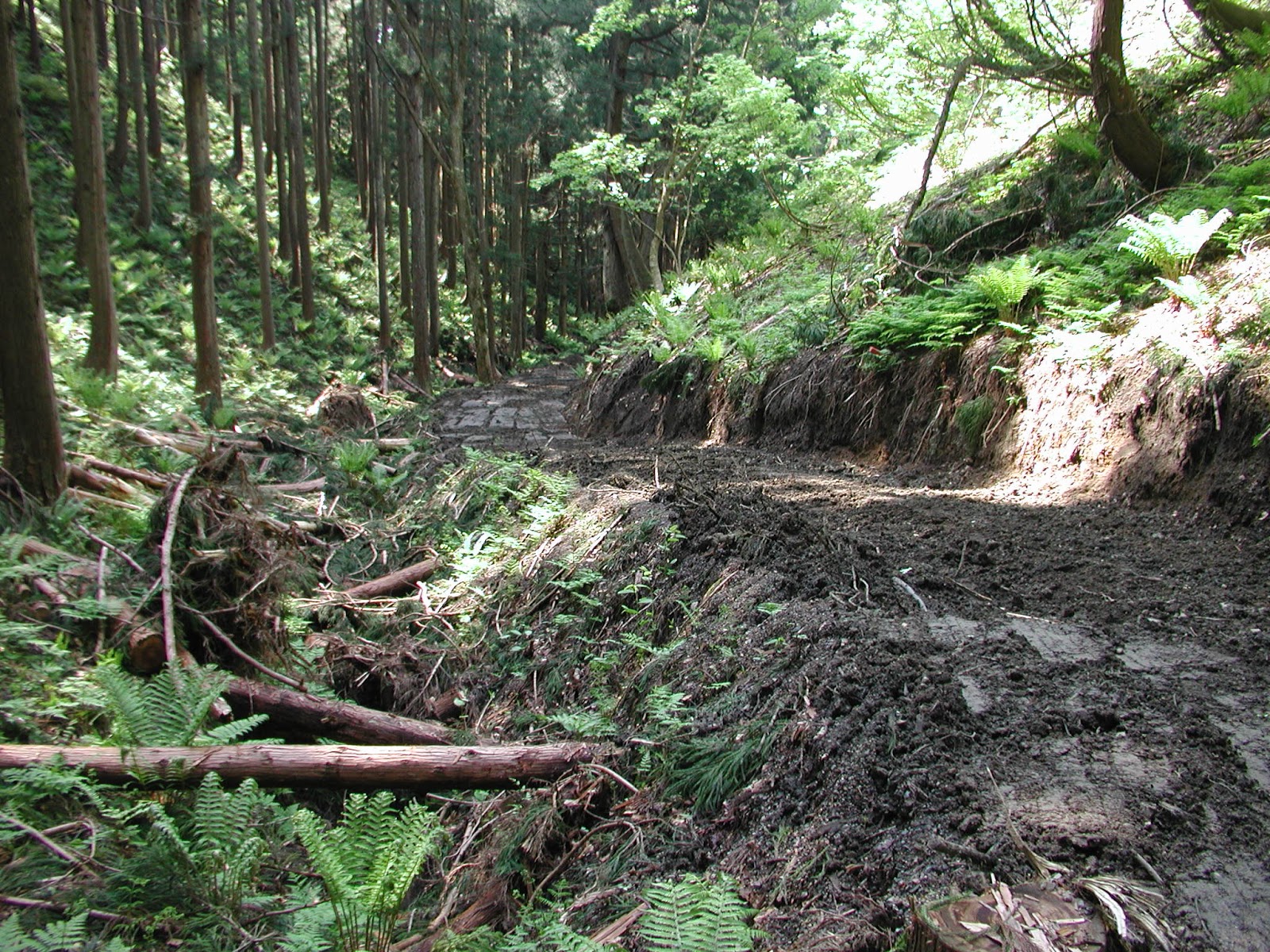
Zero-order basin where soil temperatures are monitored (0-100cm depth) at 200m asl
New forest road has been carved out of this narrow valley (starting 2012) to allow a partial cut of the cedars

Tuesday, 30 April 2013

Cool weather dampens snowmelt


Unseasonably cool weather put the brakes on the snowmelt season through late April. The peaks on the hydrograph below are more to do with rainfall events than warm weather snowmelt. This year it looks like the snowmelt season with continue well into May.