Takiya River, Niigata
Friday, 15 May 2026
New paper published on flow duration curves
Friday, 31 January 2025
New paper published on climate change impacts on seasonal runoff in the Japan Sea region
Climate change impacts on seasonal runoff in the snowy Japan Sea region of Honshu, Japan
Al- Shakil, Andrew Charles Whitaker
Hydrological Research Letters 19(1), pp 8-14
DOI: 10.3178/hrl.24-00017
Abstract
Historically, the Japan Sea region of Honshu has experienced some of the heaviest snowfalls in the world, though snowfalls are now decreasing due to global warming. This study examined changes in streamflow seasonality and trends in monthly runoff during the past 60 years at nine river basins located across Niigata, Yamagata, Akita and Aomori Prefectures. A streamflow seasonality index (Center Time, CT) was adopted, and meteorological stations paired with gauging stations to analyze the dependence of streamflow seasonality on air temperature. Overall, there is a strong tendency for winter and early snowmelt season flows to increase (December to March), while the peak snowmelt season flows in April are decreasing. In most cases, CT shows a trend for earlier seasonal runoff, and we confirm a strong linear relationship between CT and temperature during snow cover season (December to April). The relationship between CT and temperature appears to be stronger in the south of the study region (mean R2 = 0.64) than in the north (mean R2 = 0.37). In addition, the regression slope (temperature sensitivity of CT) is greater in the southern region, with an average value of –6.3 days per degree Celsius compared to –4.2 days per degree Celsius in the northern region.
Figure 1. Locations of the streamflow gauging stations in the Japan Sea region of eastern Japan
Tuesday, 28 February 2023
New paper published on long-term trends in runoff in eastern Japan
Assessing characteristics and long-term trends in runoff and baseflow index in eastern Japan
Stanley N. Chapasa, Andrew C. Whitaker
Hydrological Research Letters 17(1), pp 1-8
DOI: 10.3178/hrl.17.1
Abstract
Baseflow is the portion of streamflow derived from delayed subsurface pathways. The baseflow index (BFI) is a ratio of baseflow to total streamflow, and is an important hydrological variable when linking watershed characteristics to baseflow. The ‘smoothed minima’ procedure of baseflow separation was applied to streamflow data (29–67 years) from twenty-six gauges of watersheds in eastern Japan. The Mann-Kendall statistical test and Sen’s slope estimator were used to identify trends and estimate the rate of change in annual and seasonal runoff and BFI per decade at 0.01 and 0.05 significance levels. To the best of our knowledge, this is the first study to investigate long-term trends in runoff and BFI for watersheds in the large-scale region of eastern Japan. Results showed significant trends in annual runoff and BFI, with a concentration of significant seasonal trends occurring in winter with five gauges showing trends in runoff and nine gauges showing trends in BFI. The results suggest that the response of annual and seasonal runoff and BFI to climate change can already be seen, which implies that policymakers need more information on the impacts of climate change and human activities to manage water resources sustainably.
Figure 1. Location map showing gauges (MLIT), streams, and the digital elevation model (DEM), which was processed in ArcGIS 10.5. The DEM was sourced freely online from the ALOS World 3D 30-meter (AW3D30) DEM database (Japan Aerospace Exploration Agency, 2021)
Figure 2. Relative frequency histograms for the sample of 26 basins showing the distribution of BFI in the case of (a) annual period, (b) spring season (March–May), (c) summer season (June–August), (d) autumn season (September-November), and (e) winter season (December–February)
Friday, 2 September 2022
Largest flood on record occurs August 3rd 2022
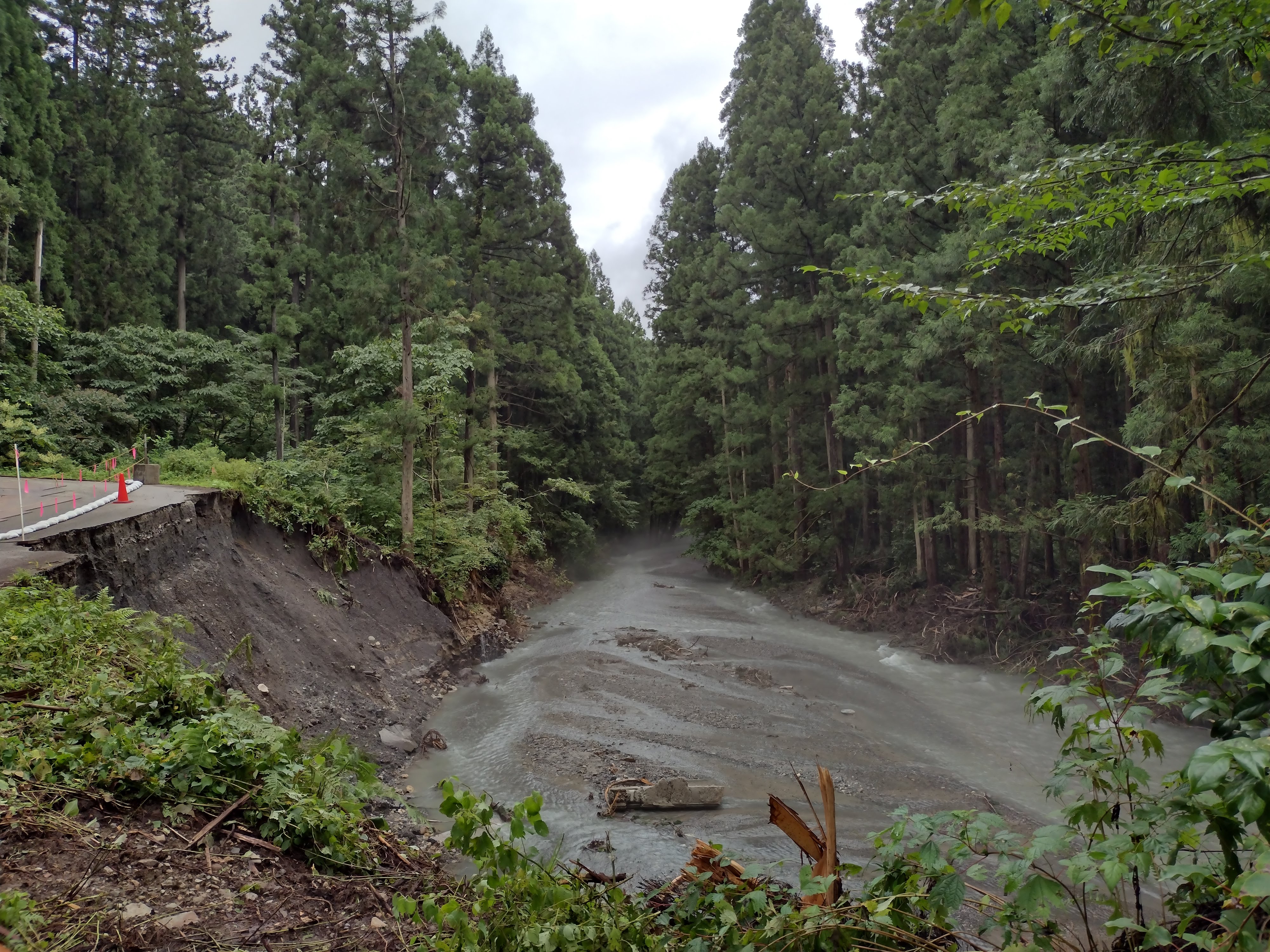
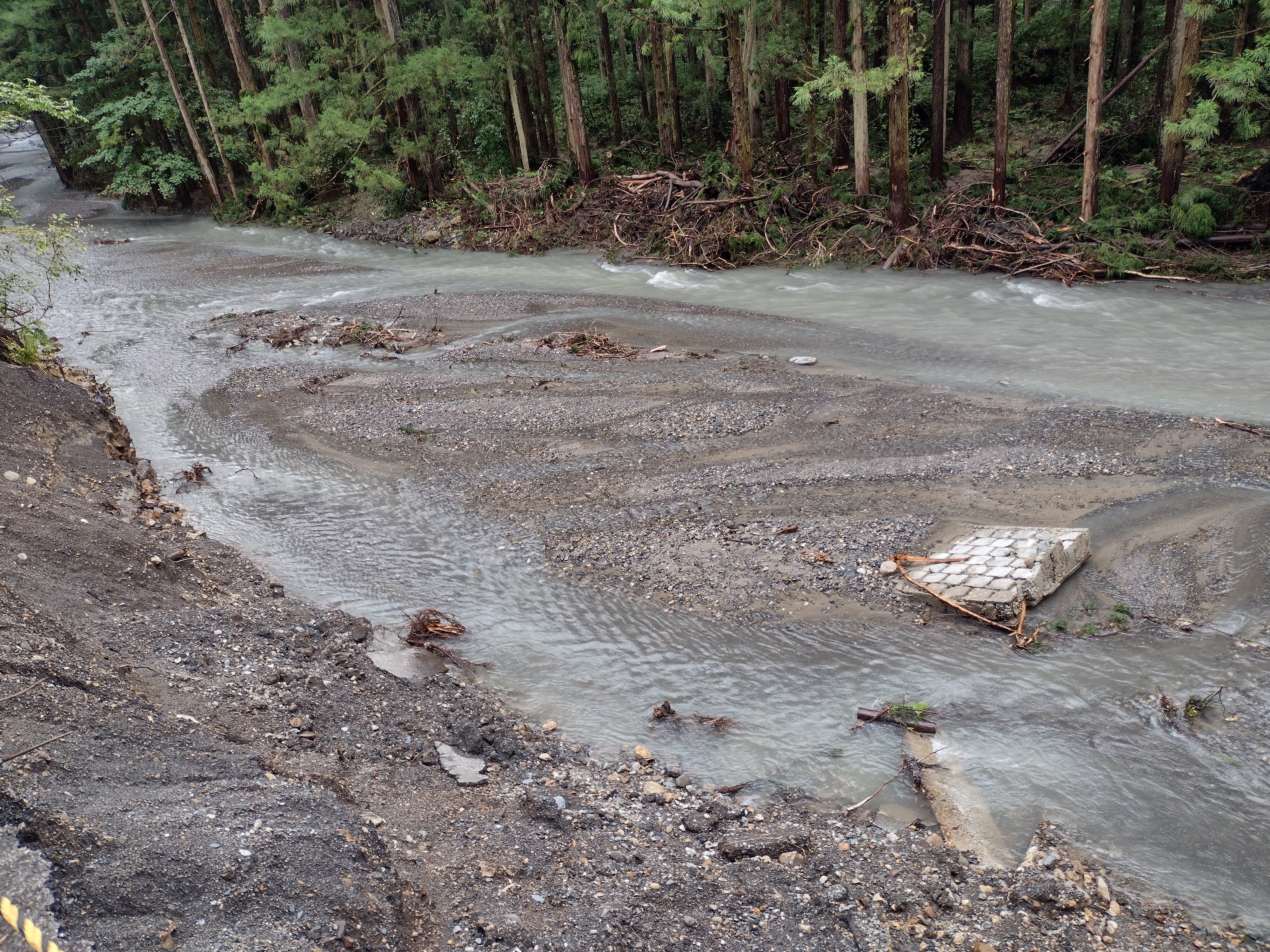
The largest flood on record (since 2000) occurred at Takiya River on August 3rd during record-setting rainfall in the region of Murakami City over August 3rd and 4th. Unfortunately there was much flood damage within Murakami City as several rivers burst their banks, and at Takiya River catastrophic bank erosion and channel aggradation took place. Damage occurred to the staff gauge and at least one of the sensors recording river stage. A second stage sensor is assumed to be buried under about 50-60 cm of fresh sediment accumulation. The whole channel reach shows a similar level of sediment accumulation (channel aggradation). The excess of sediment in the channel has led to braided channel features where multiple channels are flowing around islands of sediment accumulation.
New daily precipitation records were set at several gauges, with maximums of 397 mm/d and 396 mm/day for Ishiguro Mountain and Takane gauges respectively on August 3rd. New hourly precipitation records were also recorded, with a maximum of 149 mm/hour for Shimoseki gauge on August 4th (almost a record for the whole of Japan's Amedas database). New 10-minute precipitation records were set for two gauges, with a maximum of 30 mm/10 minute for Shimoseki gauge. The total 2-day precipitation recorded at Shimoseki was 569 mm! The data in the table below shows that the intense precipitation was extremely localized, especially on August 4th.
Daily and maximum hourly and 10-minute precipitation (mm) recorded by Japan Meteorological Agency and Miomote Dam during August 3-4, 2022
Date Gauge Daily Hourly 10-min.
August 3 Takane 396 70 20
Ishiguro Mt 397 57
Miomote Dam 260 81
Miomote 232 95 27
Shimoseki 189 52 13
Nakajo 134 37 13
August 4 Takane 18 10 6.5
Ishiguro Mt 52 14
Miomote Dam 36 15
Miomote 40 12 6
Shimoseki 380 149 30
Nakajo 158 92 23.5
The first hydrograph below shows the river stage during August 3rd to 4th, although correct recording of stage is lost when the stage is rapidly rising towards 3 metres. The sensor cable was snagged by debris and the sensor forcibly pulled out from the sensor housing in the river. We can see there were three large peaks above 2 metres up to this point. Previously, the maximum stage recorded was 2.59 metres on August 11th 2005. The second hydrograph shows the period leading up to the flood from mid-July. The flood on August 3rd occurs very suddenly after a dry period of about 10 days.
The last catastrophic flood of this magnitude, which also caused severe channel aggradation and channel instability, occurred on 11 August 2005. For the near-future we expect that it will be very difficult to monitor discharge accurately for a period of months or years as the channel adjusts to the huge pulse of sediment which has been introduced by this event. Extreme channel instability means that the rating curve is constantly shifting, so there are large errors in estimating discharge from river stage.
Tuesday, 15 March 2022
Intensive snow survey no. 4
| Active forest thinning of cedar stands at Takiya River |
This winter we are undertaking intensive snow surveys from the season of peak snow accumulation to the spring melt-off. Our objective is to investigate the influence of forest canopy characteristics on snow accumulation and melt, and in particular to compare varying levels of thinning in cedar stands.
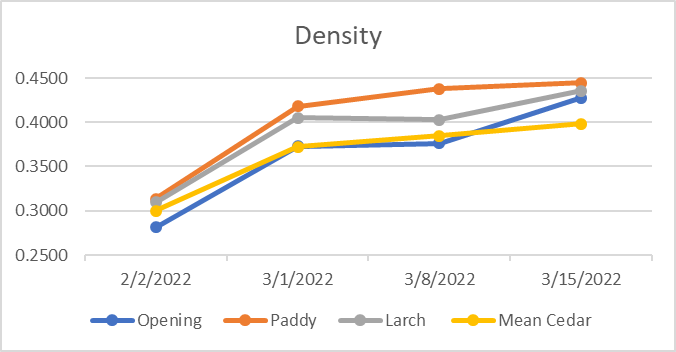
Below you can see a summary of the results from the first four surveys. Melt season is now well underway in most study plots, although surprisingly it seems the forest opening plot is still maintaining the peak level for snow water equivalent (SWE). The larch plot has been surveyed during more than 20 years, and this year shows a peak value of SWE which is the second highest on record.
| The fall of a freshly cut cedar tree is cushioned by the deep snowpack |
| Rain-on-snow conditions bring the first high flows of this winter-spring season |
Friday, 14 January 2022
New paper published on baseflow recession analysis
Citation: Andrew C. Whitaker, Stanley N. Chapasa, Cristencio Sagras, Uwitonze Theogene, Ronald Veremu & Hironobu Sugiyama (2022)
Estimation of baseflow recession constant and regression of low flow indices in eastern Japan,
Hydrological Sciences Journal
DOI: 10.1080/02626667.2021.2003368
Free access (limited time) available here:
https://www.tandfonline.com/eprint/M53RUZEPVEDISGCM6TAY/full?target=10.1080/02626667.2021.2003368
ABSTRACT
We propose a convenient procedure for the matching strip method in determining the recession constant of the master recession curve using the ratio of flow over successive days (Qn+1/Qn). The method is applied to 29 basins (6.1–740 km2) in eastern Japan to develop linear regression models that estimate low flow indices through the recession constant (λ), and either mean annual precipitation or mean annual runoff. Significant models were developed for Q710 (seven-day 10-year low flow), and Q9710 (10-year low flow exceeded 97% of the time) in the case of all basins, and in particular for basins classified into sedimentary or igneous geology (adjusted R2 up to 0.784). When basins were not classified by geology, models based on mean annual runoff as the second independent variable performed better than those based on mean annual precipitation, with adjusted R2 values of 0.705 and 0.717 for the Q710 and Q9710 models, respectively.
-------
The article includes data from Takiya River along with data from 28 other basins in eastern Japan to propose and test a new variation on the matching strip method of estimating the baseflow recession constant. The baseflow recession constant is then used in regression modelling to estimate low flow indices.
A simple spreadsheet procedure to determine the master recession curve and baseflow recession constant is included in an appendix.
![]() |
| The location figure from the article, which includes 29 basins. |
Friday, 27 August 2021
Flash flood on August 10
Intense rainfall in the early hours of August 10th caused a moderately sized flash flood, peaking at nearly 1.5 m stage. During one 10-minute interval, the stage rose by nearly 0.5 m! Rainfall intensities measured at Miomote Amedas gauge were up to 29 mm/h, with a daily total of 104 mm.
Today we measured discharge and we observed that there had been much new scouring of the streambed towards the left bank (looking upstream), and in the pool beneath the road bridge. However, the new measurement plots within 4% of the rating curve value, so no change in the H-Q curve detected.
I was glad to see that a developing potential log-jam at the lower end of the riffle below the gauging section had been shifted by the flash flood. The fallen cedar tree was rotated into a new position parallel with the bank, where it is less likely to cause a blockage.
![]() |
| Stage = 0.468 m, Q = 1.17 m3/s |
![]() |
| Developing log-jam cleared from the main channel |